With U.S. beef slaughter down, consumer prices likely to remain high
Dec. 12, 2025
By Ryan McGeeney
U of A System Division of Agriculture
Fast Facts:
- U.S. beef slaughter down 19 percent in fall quarter from 2024
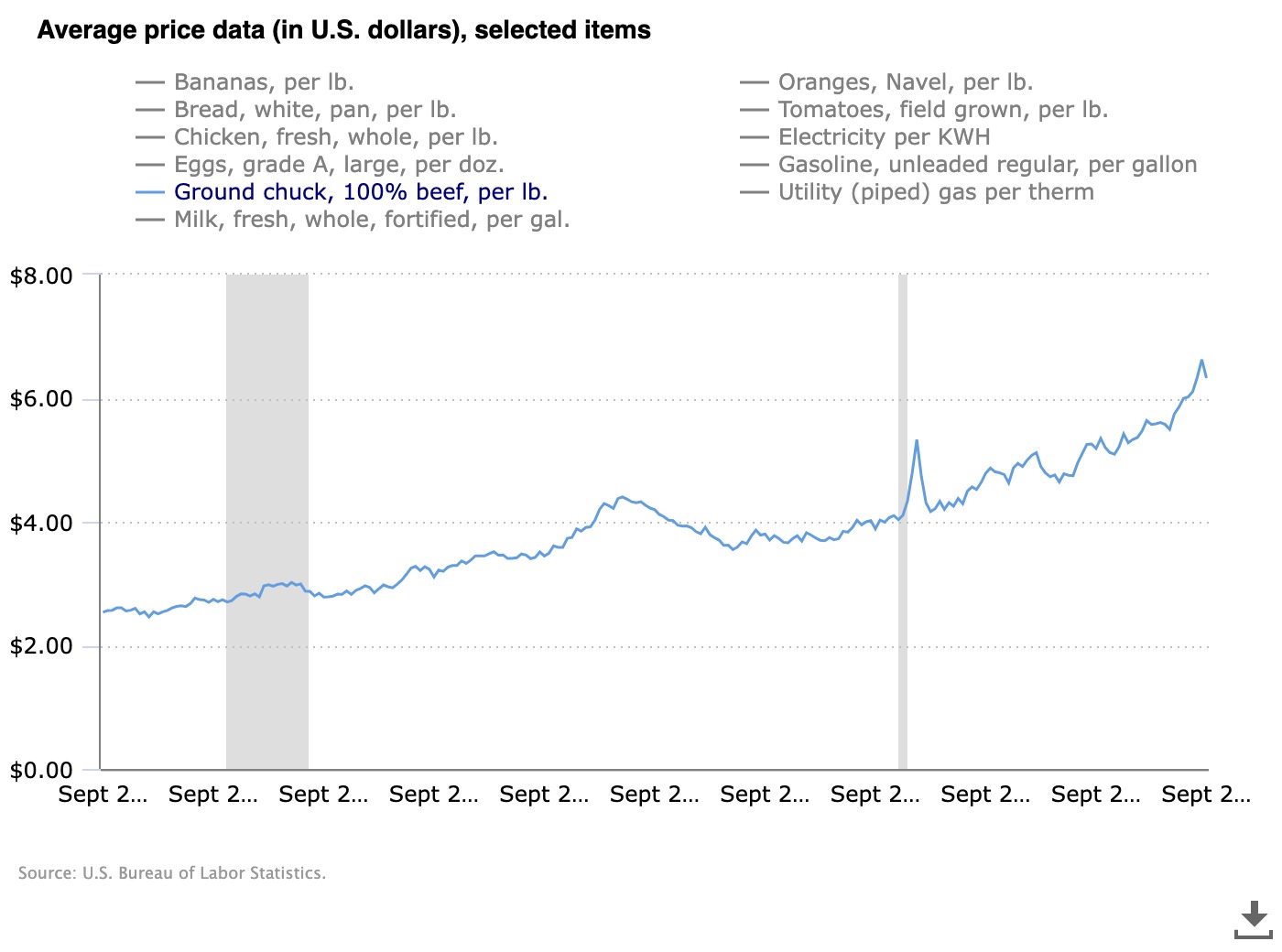
- Consumer prices for ground chuck topped $6 a pound in September
(420 words)
(Newsrooms: With graphic)
LITTLE ROCK — American beef cow slaughter fell during the fall quarter by 19 percent from the same period in 2024, according to U.S. Department of Agriculture data released in the wake of the recent federal shutdown.
James Mitchell, agricultural economist for the University of Arkansas System Division of Agriculture, said that while that may seem like a significant drop-off, context is important.
“In 2023, we had a situation where producers were actively culling deep into their herds,” Mitchell said. “In 2025, there are simply fewer cows to slaughter.”
The January 2025 U.S. beef cow and heifer inventories were lower than they had been since 1961, with approximately 27.9 million head. The Mitchell forecasts a slaughter rate of about 42 percent for the year.
Record-low national beef herd sizes in the United States have been a large part of the record-high market prices producers have enjoyed in 2025. Cattle feeders saw fed cattle prices as high as $242 per cwt over the summer in the Southern Plains, according to USDA.
Culling is a normal part of the beef production business, Mitchell said, with producers typically removing 10-20 percent of their herds every year, in part because the cattle in question are aging and less productive.
Between Aug. 30 and Nov. 15, U.S. producers slaughtered 543,586 head of cattle, Mitchell said.
“We had strong profitability the last couple of years,” he said. “Acknowledging that input costs are still high, we’ve had a couple of years of really good production and good pastures.”
More than any other segment of agriculture, cattle production is cyclical. However, Mitchell said, consumers shouldn’t look forward to beef herd expansion in the near term.
“We might see some inventory changes in January when the USDA inventory report comes out,” he said. “But market prices are so high, I think a lot of producers are happy with selling cattle.”
None of this spells lower prices for consumers in the near future, Mitchell said, even if options from South American producers have an increased presence in U.S. grocery stores.
“With slaughter down, you have less lean trimmings that you would use to make ground beef,” he said. “And so what we've seen this year is higher ground beef prices — and ground has typically been a competitive product.”
According to the U.S. Bureau of Labor Statistics, ground chuck cost an average of $6.33 a pound in September 2025, up from $5.19 in September 2023.
“The fact is that consumer prices are high, and they're probably going to get higher,” Mitchell said.
To learn about extension programs in Arkansas, contact your local Cooperative Extension Service agent or visit www.uaex.uada.edu. Follow us on X and Instagram at @AR_Extension. To learn more about Division of Agriculture research, visit the Arkansas Agricultural Experiment Station website: https://aaes.uada.edu/. Follow on X at @ArkAgResearch. To learn more about the Division of Agriculture, visit https://uada.edu/. Follow us on X at @AgInArk.
About the Division of Agriculture
The University of Arkansas System Division of Agriculture’s mission is to strengthen agriculture, communities, and families by connecting trusted research to the adoption of best practices. Through the Agricultural Experiment Station and the Cooperative Extension Service, the Division of Agriculture conducts research and extension work within the nation’s historic land grant education system.
The Division of Agriculture is one of 20 entities within the University of Arkansas System. It has offices in all 75 counties in Arkansas and faculty on three campuses.
Pursuant to 7 CFR § 15.3, the University of Arkansas System Division of Agriculture offers all its Extension and Research programs and services (including employment) without regard to race, color, sex, national origin, religion, age, disability, marital or veteran status, genetic information, sexual preference, pregnancy or any other legally protected status, and is an equal opportunity institution.
# # #
Media Contact:
Ryan McGeeney
rmcgeeney@uada.edu
501-671-2120