Guide Now Available for Volunteers Collecting Voter Signatures
Jan. 6, 2026
By Kristin Netterstrom Higgins
U of A Division of Agriculture
Fast Facts:
- Public Policy Center, Arkansas Civic Action Network produced guide
- Find guide at uada.edu/ballot or www.arkaction.net
- Guide helps volunteers navigate signature collection process
- Gives volunteers clear, consistent, legally accurate information
(526 words)
(Newsroom: Guide cover art )
LITTLE ROCK — Arkansas volunteers who gather the tens of thousands of voter signatures needed to qualify a constitutional amendment or state law for the statewide ballot now have access to a guide written especially for their civic role.
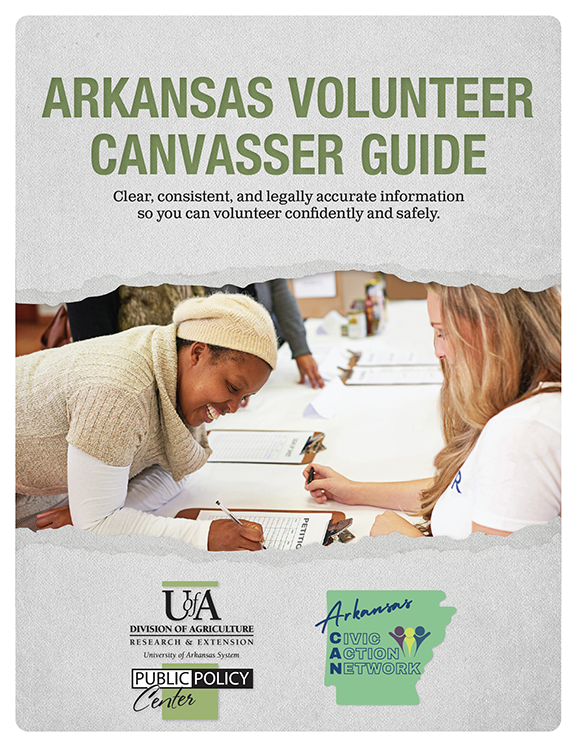
The Arkansas Volunteer Canvasser Guide includes helpful tips and information about new state laws so volunteers can better navigate the signature collection process. Arkansas Civic Action Network and the Public Policy Center at the University of Arkansas Division of Agriculture partnered on producing the guide.
“Our number one goal is for canvassers to feel confident in their role of volunteer,” said Gail Choate, executive director of Arkansas Civic Action Network, a Little Rock-based nonpartisan, nonprofit organization that engages Arkansans in civic life through education, workshops and community projects.
Choate and Kristin Netterstrom Higgins from the Public Policy Center wrote the guide after legislators passed several new canvassing laws establishing misdemeanor and felony crimes.
“Our shared goal is to give volunteers clear, consistent, and legally accurate information so Arkansans can volunteer confidently and safely,” Choate said.
The guide is available on both organizations’ websites: uaex.uada.edu/ballot and www.arkaction.net. The guide discusses what a petition is and what the canvasser is responsible for during the signature collection process. The guide also notifies volunteers that recent laws requiring canvassers to check a voter’s photo ID and to witness voters read the ballot title are on hold as part of a federal lawsuit.
The signature collection process is where most ballot issue groups see their campaign efforts flail, said Netterstrom Higgins, who publishes a neutral statewide ballot issue voter guide each election cycle.
“The petitions are just one step of an intense process, but they’re often challenged in lawsuits seeking to stop a constitutional amendment from being put on the ballot for voters to decide,” Netterstrom Higgins said. “Either a canvasser didn’t sign a petition correctly or a campaign may have overlooked one of the many affidavits they have to submit about paid and volunteer canvassers.”
To qualify a constitutional amendment for the 2026 statewide ballot, a ballot question committee must collect at least 90,704 voter signatures from at least 50 counties. The number of signatures required represents 10 percent of the number of people who voted in the last governor’s election. For a state law, it’s 72,563 voter signatures, or 8 percent, of the number of people who cast a ballot in the last governor’s election.
“Volunteers have been the heart of many grassroots ballot issue campaigns for the past 100 years Arkansas has had the direct democracy process. This guide is a tool to keep that momentum going,” Netterstrom Higgins said.
The Public Policy Center, located at the Cooperative Extension Service state office in Little Rock, has provided Arkansans with research-based information and education about public issues since 2004. To learn more, visit uaex.uada.edu/ppc or follow on Facebook at @uappc.
Follow Extension on Facebook at Arkansas.extension and on X and Instagram at @AR_Extension. To learn more about Division of Agriculture research, visit the Arkansas Agricultural Experiment Station website: https://aaes.uada.edu. Follow on X at @ArkAgResearch. To learn more about the Division of Agriculture, visit https://uada.edu/. Follow us on X at @AgInArk.
About the Division of Agriculture
The University of Arkansas Division of Agriculture’s mission is to strengthen agriculture, communities, and families by connecting trusted research to the adoption of best practices. Through the Agricultural Experiment Station and the Cooperative Extension Service, the Division of Agriculture conducts research and extension work within the nation’s historic land grant education system.
The Division of Agriculture is one of 20 entities within the University of Arkansas System. It has offices in all 75 counties in Arkansas and faculty on three campuses.
Pursuant to 7 CFR § 15.3, the University of Arkansas Division of Agriculture offers all its Extension and Research programs and services (including employment) without regard to race, color, sex, national origin, religion, age, disability, marital or veteran status, genetic information, sexual preference, pregnancy or any other legally protected status, and is an equal opportunity institution.
# # #
Media Contact: Kristin Netterstrom Higgins
khiggins@uada.edu
501-671-2160