Poultry houses, farm structures bear brunt of heavy snowfall
Jan. 28, 2026
By Ryan McGeeney
University of Arkansas Division of Agriculture
Fast Facts
- Poultry houses, other farm structures collapsed in multiple counties
- Pre-storm drought conditions mean cattle producers must break ice for water
(1,038 words)
Download photos of storm damage
LITTLE ROCK — With as much as 12 inches of snow and 2 inches of sleet reported in areas across Arkansas, the winter storm that covered much of the country over the weekend has taken an especially high toll on poultry houses and other farm structures across the state.
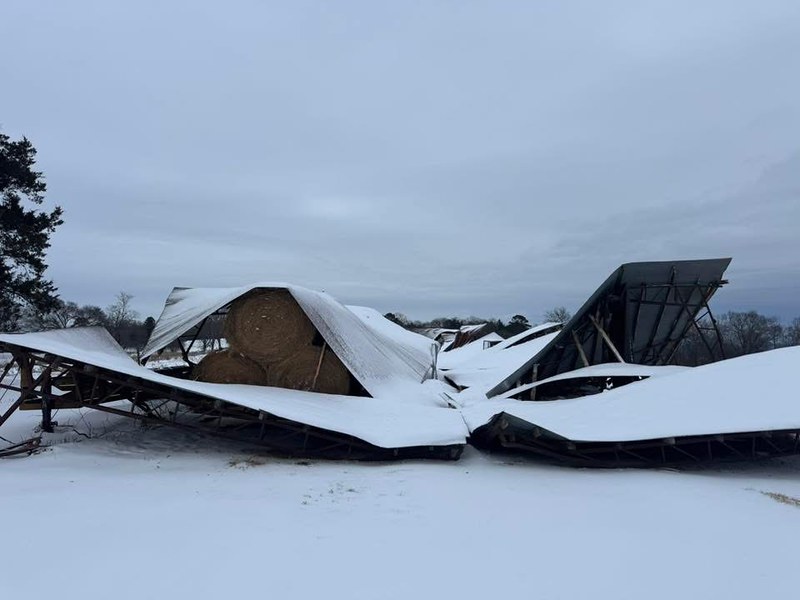
Although it will likely be some time before the extent of damaged poultry houses and impacted flocks is known, multiple county agents with the Cooperative Extension Service have reported dozens of collapsed structures in their respective counties.
Widespread collapses
Kimberly Rowe, Hempstead County agriculture agent for the University of Arkansas Division of Agriculture, said “several pullet houses have collapsed around the McCaskill area.
“The grower said these were older structures and birds were being relocated to other houses on his farm,” Rowe said. “Regionally, the count for downed poultry houses, primarily broiler houses, is estimated to be in the 30s and continuing to rise.
“The brunt of the devastation is being taken by our poultry producers,” she said, although other producers are certainly feeling the impact.
“One high tunnel in the county has been reported as a total loss,” Rowe said. “All others have survived without any known damage. The cattle producers I've talked to were able to prepare well and are reporting minimal to no losses. A barn that housed a couple of our 4-H’ers’ show goat stock collapsed, but thankfully, the animals were not injured.
“Damages to the strawberry crop are unknown at this time with ice still fully encapsulating the row covers,” she said. “One local honey producer I talked to will assess his beehives once we warm up and they're able to be fed. Overall, it seems we fared better than some of our neighboring counties, but more will be known after we thaw.”
Even as the worst of the storm passed, damage continued to mount throughout the week. Just after noon on Wednesday, the historic Barry’s Grocery & Market in Hope, an older brick structure with a flat roof, suffered a partial collapse. According to local media, the store was empty at the time, and no injuries were reported.
Bobby Powell, Yell County extension staff chair, said about 70 poultry houses throughout the Arkansas River Valley have collapsed. Many of those houses, he said, were older structures that were no longer insured against collapse.
“A lot of those farmers are just stuck,” Powell said. “They’re not going to get any insurance money for those — it’s going to be tough. Many producers will have to rebuild and go into major debt to keep their farms going.
“A lot of old chicken houses were being used for hay and equipment storage,” he said. “One guy I talked to, his barn collapsed with all his hay and tractor inside, and he had no way of feeding his cows. And this is a time when you need to get hay out. So he was relying on neighbors to come and feed hay and stuff.”
Powell said that while the 5 to 6 inches of snow that Yell County received over the weekend was likely manageable by most structures, the 2 inches of sleet that fell on top of it was particularly heavy, likely pushing many structures past the tipping point.
“There’s a lot of damage around here, and it’s going to take time for farmers to get back to where they need to be,” he said. “To get their hay and equipment out and rebuild.”
Good Samaritans
Eva Langley, Pike County extension staff chair, said structural collapses had been reported throughout her county, including more than a dozen chicken houses and boat dock shelters at each of the county’s three marinas.
As many county roads remain impassable, Langley said that some poultry producers are running out of feed and are having a hard time getting more.
“We’ve had three feed trucks that have been ditched trying to get to chicken houses for feed,” Langley said. “They’re not able to get to them.”
She said that some producers have taken to putting out distress calls on social media, and neighbors capable of traversing the roads are answering the call.
“There are people on social media asking for help feeding animals, and there are others responding, ‘tell me where you live,’” she said. “The people with vehicles that can get out and drive, they’re being good neighbors and mounting rescues.”
The winter ahead for cattle
Faulkner County extension agriculture agent Kevin Lawson said that while his area had seen relatively few structural collapses, cattle producers were working overtime to make sure herds had access to forage and drinking water.
“It’s a unique storm, because we were in a D-3 drought when this happened,” Lawson said. “I had a producer in his 50s tell me that this will be the first time they’ll have to break ice — he’s always had streams running through the farm to keep water. But this year was so dry that nothing was running.
“But they knew that going into the weekend,” he said. “They had plenty of warning to get their cattle together. I heard from plenty of people in this situation, who had dry creeks, dry streams and no water running through their farms.”
Jonathan Kubesch, extension forage specialist for the Division of Agriculture, said that for cattle producers, his top concerns boiled down to hay feeding, the health of annuals and thaw damage to feeding areas.
“The entire state has been at some level of drought since the start of the month,” Kubesch said. “With a La Niña pattern in play, we are already feeding a lot more hay than we might have otherwise. As we come out of this storm, we likely had to feed more hay to match increased animal demand. I am mindful that hay inventories might end up lower than anticipated.
“I fielded a call about whether to graze winter annual seedlings before the storm,” he said. “I suggested waiting, hoping to maintain the stand for more grazing later in the winter. While most folks have cold-hardy winter annuals, I am interested in seeing how much this storm sets back some of these plantings, or if the thaw will give us some additional growth with the sudden flush of moisture.”
To learn about extension programs in Arkansas, contact your local Cooperative Extension Service agent or visit uaex.uada.edu. Follow us on Facebook and Instagram. To learn more about the Division of Agriculture, visit uada.edu. To learn more about ag and food research in Arkansas, visit the Arkansas Agricultural Experiment Station at aaes.uada.edu.
About the Division of Agriculture
The University of Arkansas Division of Agriculture’s mission is to strengthen agriculture, communities, and families by connecting trusted research to the adoption of best practices. Through the Agricultural Experiment Station and the Cooperative Extension Service, the Division of Agriculture conducts research and extension work within the nation’s historic land grant education system.
The Division of Agriculture is one of 20 entities within the University of Arkansas System. It has offices in all 75 counties in Arkansas and faculty on three campuses.
Pursuant to 7 CFR § 15.3, the University of Arkansas Division of Agriculture offers all its Extension and Research programs and services (including employment) without regard to race, color, sex, national origin, religion, age, disability, marital or veteran status, genetic information, sexual preference, pregnancy or any other legally protected status, and is an equal opportunity institution.
# # #
Media Contact:
Ryan McGeeney
rmcgeeney@uada.edu
501-671-2120