Persistent wind, rain to make rice fertilization a ‘spoon-feeding’ affair
June 19, 2026
By Ryan McGeeney
University of Arkansas Division of Agriculture
Fast Facts
- Rain, wind preventing timely fertilizer applications for many rice farmers
- Many will likely need to ‘spoon-feed’ nitrogen throughout the season
- 2026 Arkansas rice acreage could be as low as 800,000acres
(355 words)
Download photo
LITTLE ROCK — Ongoing weather concerns will likely mean many Arkansas rice farmers will need to dole out nitrogen fertilizer throughout the growing season, rather than apply it prior to flood this year.
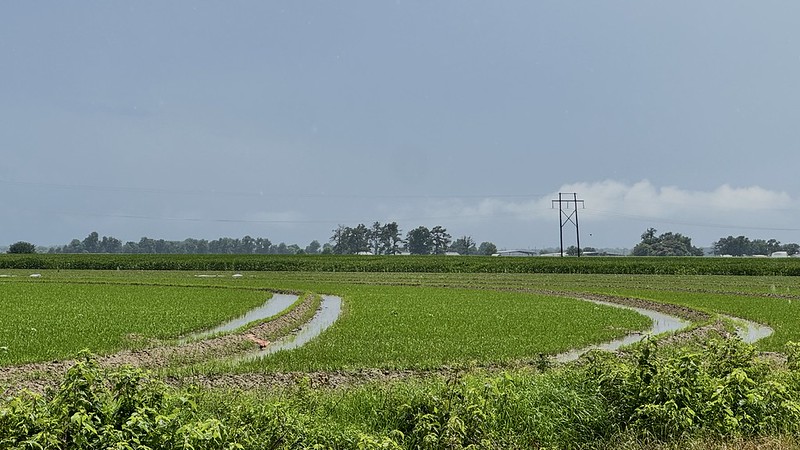
Jarrod Hardke, extension rice agronomist for the University of Arkansas Division of Agriculture, said that after winter-long drought conditions through much of the Delta, farmers are hoping to make up for lost time with late-spring rains without being completely gully-washed.
“We’re grateful for the rainfall, but it’s coming at a time when we need to be applying herbicides to clean up some of our weeds before going to flood,” Hardke said. “Our most efficient method of nitrogen fertilization is putting it on dry ground before flood. That’s our ideal scenario, and we’re getting very narrow windows to accomplish much of that for the crop.”
The past several weeks, Hardke said, have alternately been marked by very wet conditions and, when dry, high winds. In addition to nitrogen, the conditions also make it difficult to apply herbicide, he said.
According to the U.S. Department of Agriculture’s National Agricultural Statistics Service, 100 percent of Arkansas’ projected rice acreage — which Hardke now estimates at about 800,000 acres — had been planted by the last week of May, and 95 percent of that had already emerged. In the weeks that have followed, significant rain events have marked the weekends across much of the state.
“It’s making a tough weed control year tougher because we can’t make the weed control applications we need to,” Hardke said. “It’s just been a fight.
“It’s hard to win on any day,” he said. “We’re doing the best we can in sub-optimal conditions.”
While farmers can still make a profitable crop by adapting their fertilization schedule, it will likely eat into that profit through higher labor and nitrogen expenditures.
“Instead of one large application earlier in the season, you’re having to spoon-feed it, making multiple small applications throughout the season,” Hardke said. “I don’t like spoon-feeding, but it works. When we run out of time to do it the preferred, recommended way, this is the strategy we’re left with, most of the time.”
To learn about extension programs in Arkansas, contact your local Cooperative Extension Service agent or visit uaex.uada.edu. Follow us on Facebook and Instagram. To learn more about the Division of Agriculture, visit uada.edu. To learn more about ag and food research in Arkansas, visit the Arkansas Agricultural Experiment Station at aaes.uada.edu.
About the Division of Agriculture
The University of Arkansas Division of Agriculture’s mission is to strengthen agriculture, communities, and families by connecting trusted research to the adoption of best practices. Through the Agricultural Experiment Station and the Cooperative Extension Service, the Division of Agriculture conducts research and extension work within the nation’s historic land grant education system.
The Division of Agriculture is one of 22 entities within the University of Arkansas System. It has offices in all 75 counties in Arkansas and faculty on three campuses.
Pursuant to 7 CFR § 15.3, the University of Arkansas Division of Agriculture offers all its Extension and Research programs and services (including employment) without regard to race, color, sex, national origin, religion, age, disability, marital or veteran status, genetic information, sexual preference, pregnancy or any other legally protected status, and is an equal opportunity institution.
# # #
Media Contact:
Ryan McGeeney
rmcgeeney@uada.edu
501-671-2120