Arkansas soybean breeding lines yield peptides with food-preserving potential
Nov. 23, 2026
By John Lovett
University of Arkansas Division of Agriculture
Fast Facts
- Two Arkansas soybean breeding lines show strong antioxidant activity
- Soybean peptides could offer alternatives to synthetic antioxidants used in some foods
- Researchers evaluating performance of soy-based peptides in mayonnaise
(804 words)
Download PHOTOS of soybeans and researchers
FAYETTEVILLE, Ark. — Two soybean breeding lines from the University of Arkansas Division of Agriculture have shown promise as sources of natural compounds that could help food manufacturers slow oxidation and preserve product quality.

A study published in Food Chemistry found that small protein fragments called peptides derived from two of the eight high-protein soybean varieties tested had particularly strong antioxidant properties. The peptides could eventually offer an alternative to synthetic ingredients used to slow oxidation in foods such as mayonnaise and salad dressings.
“Lipid oxidation is one of the major reasons foods lose quality during storage,” said Mahfuzur Rahman, an assistant professor of grain processing in the department of food science for the Arkansas Agricultural Experiment Station, UADA's research arm. “Our goal was to identify natural compounds from Arkansas soybeans that can help preserve food quality while meeting consumer demand for cleaner ingredient labels.”
Tiny protein fragments, big potential
Peptides are short chains of amino acids produced when larger proteins are broken down through a process called hydrolysis. Although proteins are commonly used as food ingredients, breaking them into smaller peptides can reveal additional functional properties, including the ability to slow oxidation.
Food manufacturers commonly use antioxidants to slow oxidation. Some products also contain synthetic compounds such as ethylenediaminetetraacetic acid, or EDTA, which binds to metals like copper, iron and zinc in food that can accelerate oxidation.
“When you see a label that says ‘antioxidant used for freshness,’ that is the exact thing we are trying to replace,” Rahman said. “When you talk about any gel-type or emulsion-type food, like mayonnaise, then you will see something called EDTA. It is very controversial. We want to remove or replace the EDTA from those food products."
Understanding how foods stay fresh
When fats and oils react with oxygen, they gradually degrade food quality and produce undesirable flavors and odors. It is one reason nuts, oils and other foods can develop rancid or stale flavors during storage.
Sukanya Poddar, a food science Ph.D. student and the study’s lead author, said emulsion-based foods such as mayonnaise and ranch dressing are particularly vulnerable to quality changes associated with oxidation because they can lose texture and stability as they deteriorate.
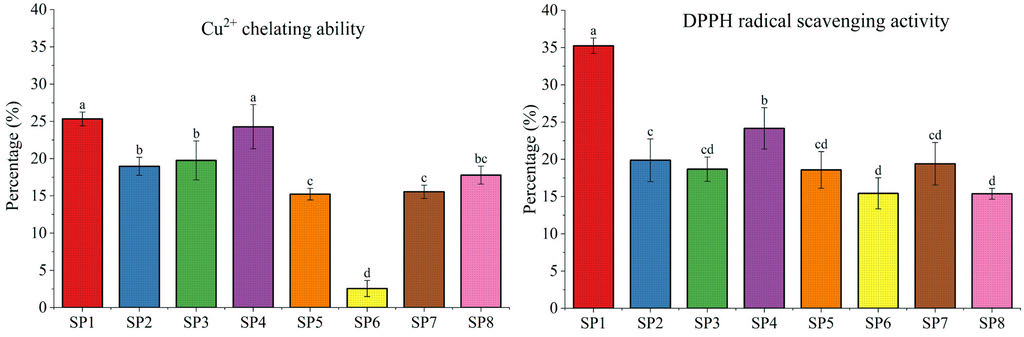
With Rahman’s research team, Poddar, evaluated the soybean peptides for their ability to slow oxidation through two mechanisms: free radical scavenging and metal chelation.
Free radicals are unstable molecules that can trigger oxidation reactions. Antioxidants help neutralize them before they damage fats and oils.
Metal chelation involves binding metals such as iron and copper. Although these metals are important nutrients, they can also act as oxidation catalysts.
“What those peptides do is actually bind with iron and copper ions and make them inactive so that they cannot initiate oxidation,” Poddar explained.
New opportunities for growers
The study, funded by the Arkansas Soybean Promotion Board through soybean producer checkoff funds, found that peptides from all eight soybean varieties demonstrated some metal-chelating ability. However, two varieties stood out.
The top-performing varieties, identified in the study as SP1 and SP4, correspond to UADA breeding lines R11-7999 and R05-1772, respectively. Both showed stronger antioxidant performance than the other varieties tested in analysis of metal chelation and free radical scavenging.
The soybeans also maintained competitive yield, said Caio Vieira, an assistant professor of soybean breeding in the department of crop, soil and environmental sciences and co-author of the study.
While the top-performing UADA soybean varieties from the study are not commercially available, the research provides valuable input for the Arkansas Soybean Breeding program. The program develops and releases high-yielding commodity and specialty soybean varieties tailored to the needs of Arkansas growers, including herbicide-resistant soybean cultivars.
Vieira, who leads the Arkansas Soybean Breeding Program, was also a co-principal investigator on the Arkansas Soybean Promotion Board grant with Rahman and expressed excitement for the new potential uses for soybean-derived products.
“With lower commodity prices and strong competition, developing varieties with seed composition traits tailored to specific food uses could help Arkansas soybeans stand out in the marketplace and create opportunities for growers to earn more per acre,” Vieira said.
Ultimately, Rahman hopes the findings will contribute to the development of new food ingredients that help preserve product quality and provide food manufacturers with more clean-label formulation options.
“If we can develop a high-protein variety with peptides that provide specific properties, and the activity of those peptides is equivalent to chemical preservatives like EDTA, that would be a breakthrough,” Rahman said.
The work remains in the research phase, with testing the peptides in food products in mayonnaise to better understand how they perform in a more complex food system.

About the researchers
Co-authors of the study included Parvej Hasan Jon, a graduate assistant in the department of food science at the University of Arkansas, and Kaustav Majumder, an associate professor of food science and technology at the University of Nebraska-Lincoln.
To learn more about ag and food research in Arkansas, visit aaes.uada.edu. Follow the Arkansas Agricultural Experiment Station on LinkedIn and sign up for our monthly newsletter, the Arkansas Agricultural Research Report. To learn more about the Division of Agriculture, visit uada.edu. To learn about extension programs in Arkansas, contact your local Cooperative Extension Service agent or visit uaex.uada.edu.
About UADA
The University of Arkansas Division of Agriculture’s mission is to strengthen agriculture, communities, and families by connecting trusted research to the adoption of best practices. Through the Agricultural Experiment Station and the Cooperative Extension Service, the Division of Agriculture conducts research and extension work within the nation’s historic land- grant education system.
The Division of Agriculture is one of 22 entities within the University of Arkansas System. It has offices in all 75 counties in Arkansas and faculty on three system campuses.
Pursuant to 7 CFR § 15.3, the University of Arkansas Division of Agriculture offers all its Extension and Research programs and services (including employment) without regard to race, color, sex, national origin, religion, age, disability, marital or veteran status, genetic information, sexual preference, pregnancy or any other legally protected status, and is an equal opportunity institution.
# # #
Media Contact:
John Lovett
U of A Division of Agriculture
Arkansas Agricultural Experiment Station
(479) 763-5929
jl119@uark.edu