Posts
Contact
Luke Pullo
CPED
Phone: 501-671-2286
Email: lpullo@uada.edu
University of Arkansas Division of Agriculture
Cooperative Extension Service
2301 S. University Avenue
Little Rock, AR 72204
Housing Cost Burden and Economic Development in Arkansas
Quality, affordable and accessible housing is a cornerstone of community economic development. When residents can secure stable housing without experiencing a cost burden, they are better positioned to participate in the local economy and contribute to long-term community vitality. However, while Arkansas is generally known for being a state with lower housing costs, communities across the state are confronting acute and growing housing challenges that undermine quality of life and long-term resiliency. Both Little Rock and Fayetteville have declared housing crises in 2026 and 2024, respectively, signaling that affordability concerns have become broad policy issues affecting entire communities (Gafner, 2026; City of Fayetteville, Arkansas, n.d.).
Federal data from the U.S. Census Bureau and U.S. Department of Housing and Urban Development reinforces the housing crisis, revealing that a significant share of Arkansans face housing challenges. These pressures are making it more difficult for communities to strengthen their local economies, retain and attract workers, and improve overall quality of life.
A Significant Share of Arkansans are Cost Burdened
The U.S. Department of Housing and Urban Development recommends that households spend no more than 30% of their monthly income on housing costs. Households that spend more than 30% of their income on housing costs are considered cost burdened while those that spend more than 50% of their income on housing costs are considered severely cost burdened (McCarty, Daniels, & Keightley, 2025). When households are cost burdened, they have less money to spend on essentials, discretionary spending, and savings, making financial stability and economic participation more difficult to achieve.
According to latest Comprehensive Housing Affordability Strategy estimates, about 23% of households in Arkansas were spending more than 30% of their income on housing. While this is lower than the national average, this is about one in five Arkansas households face housing affordability challenges. Renters are more likely to face housing affordability challenges with about 38%, or about four in 10 renters struggling to afford gross rent. Rising rents and limited supply are continuing to create barriers to housing for young adults, single renters, and racial and ethnic minorities, who are disproportionally represented among cost-burden renters (U.S. Department of Housing and Urban Development, 2025; U.S. Census Bureau, 2026; Arkansas Economic Development Commission, Arkansas Development Finance Authority, & Arkansas Department of Health, 2025).
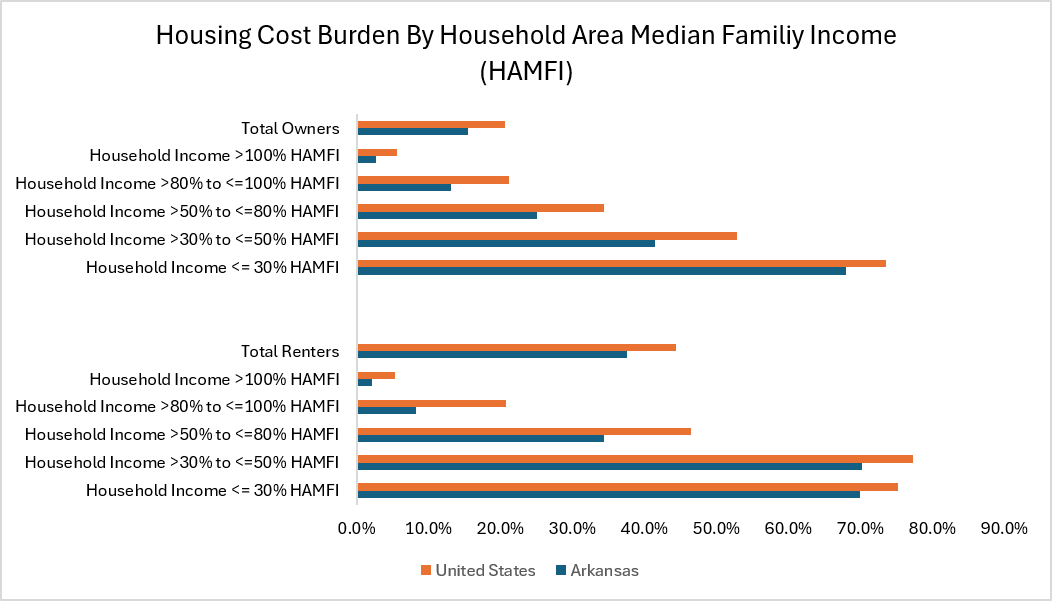
Source: HUD Comprehensive Housing Affordability Strategy (CHAS), 2025. Based on 2018 -2022 ACS 5-Year Estimates
Low-income households face difficult affordability pressures. Households earning below 80% of the Household Area Median Family Income (HAMFI) are more likely to be considered cost burdened compared to high income households. A majority of renters and homeowners below 50% HAMFI are cost burdened. For these households, modest increases in housing costs can push households into housing instability. Workers with low-to-moderate income occupations who make the backbone of local economies, such as food preparation and serving related occupations, retail sales workers, home health and personal care aides, and agricultural processing workers are likely to feel the squeeze. This is limiting the state’s ability to maintain a stable workforce.
While households greater than 100% HAFMI do not face substantial cost burdening on average, they are not insulated from the housing crisis. In rapidly growing regions of the state, such as Northwest Arkansas, housing production has not kept up with both market demand and population and economic growth, increasing pressure on the housing market (Walton Family Foundation, 2025). Households across all income levels compete for a limited supply of homes, which puts pressure on home and rent prices. Higher-income households who face market competition may delay homeownership, potentially compete for housing that is also affordable for lower-income households, or expand their housing search to other communities. These pressures can create housing challenges throughout the entire market.
Strategies to Address the Housing Crisis
Housing affordability is as much an economic development issue as it is a housing issue. Addressing the housing crisis in Arkansas will require collaborative and intentional strategic planning between the business community, municipalities, and developers. To address the housing issue, the state and localities should look to policies that would make affordable housing more feasible. This includes reforming and expanding financing tools that make below market rate development more feasible, such as the Low-income Housing Tax Credit (LIHTC) and the Arkansas Housing Trust Fund (Walton Family Foundation 2025; National Low-Income Housing Coalition, 2026). Zoning reform that allows greater housing density and a diversity of housing types to be more feasible could increase the supply of housing over time (National Low-Income Housing Coalition, 2026).
Communities should also explore mechanisms that lower land acquisition and development costs, such as public-private partnerships, ground leases, or discounted land transfers of publicly owned land (National Low-Income Housing Coalition, 2026; Walton Family Foundation 2025).
Housing is an essential land use for communities, and such strategies will improve affordability and strengthen the economic competitiveness of Arkansas communities. Policy changes, such as zoning reform, require heavy government and community backing and take time. Collective action between governments, developers, businesses, and community organizations will be critical in increasing housing supply and affordability. By approaching housing as an economic development strategy, communities make strides in improving the quality of life of their residents.
Reference List
City of Fayetteville, Arkansas. (n.d.). Housing policy. City of Fayetteville. https://www.fayetteville-ar.gov/4458/Housing-Policy
Gafner, M. (2026, March 17). Little Rock declares housing crisis as federal scrutiny exposes deeper issues. KARK. https://www.kark.com/news/local-news/little-rock-declares-housing-crisis-as-federal-scrutiny-exposes-deeper-issues/
McCarty, M., Daniels, M. & Keightley, M.P. (2025, March 11). Housing cost burdens in 2023: In brief (CRS Reports No. R48450). Congressional Research Service. https://www.congress.gov/crs_external_products/R/PDF/R48450/R48450.2.pdf
National Low Income Housing Coalition. (2026). 2026 Arkansas Housing Profile. https://nlihc.org/sites/default/files/SHP_AR.pdf
U.S. Census Bureau. (2026a). 2020- 2024 American Community Survey 5-year Public Use Microdata Samples [dataset]. https://data.census.gov/
U.S. Department of Housing and Urban Development. (2023). Comprehensive Housing Affordability Strategy. [dataset]. https://www.huduser.gov/portal/datasets/cp.html
Walton Family Foundation. (2025). Our Housing Future: A Call to Action for Northwest Arkansas. https://static.waltonfamilyfoundation.org/93/1a/ 2ed20c6340e6ac 95149721dc11cc/our-housing-future-report.pdf