Northeast Arkansas farmers consider replants after June rainfall event
July 10, 2026
By Ryan McGeeney
University of Arkansas Division of Agriculture
Fast Facts
- Significant rainfall hit northeast Arkansas during late June event
- Some crop fields will require replants
- Peanut growers will need to consider applying extra nitrogen
(791 words)
Download photos of flooded areas
HARRISBURG, Ark. — By the time Michael Chaney, Poinsett County extension staff chair for the University of Arkansas Division of Agriculture, emptied 7 inches of rain from the rain gauge at the county extension office on June 22, he knew the area was in for a deluge.
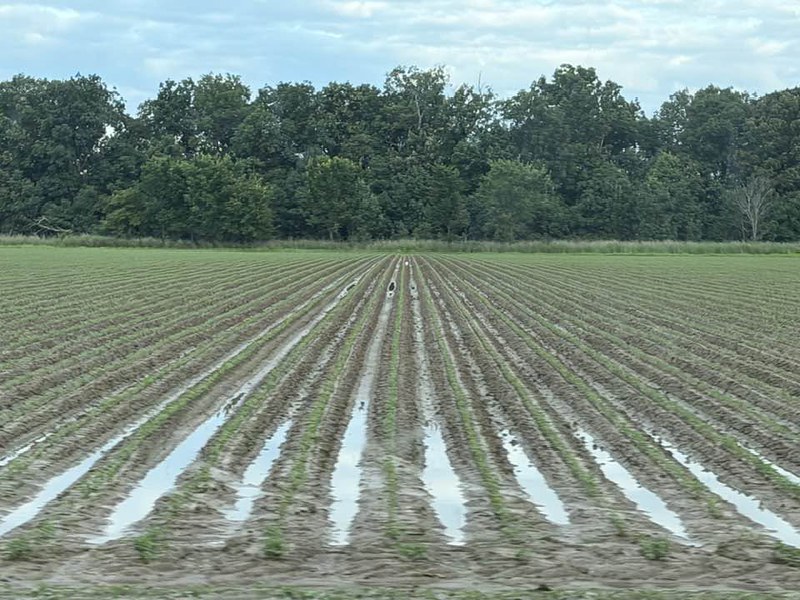
“We dumped it out, then somehow got three more inches,” Chaney said.
The torrential rainfall that Monday put row crops and residential areas under significant water throughout much of the northeastern corner of Arkansas. Ana Morales-Ona Smith, extension soil fertility specialist for the Division of Agriculture, posted drone footage of the area around the Northeast Rice Research and Extension Center in Poinsett County on social media, showing research plots and other crop fields partially submerged in the immediate aftermath of the rain event, as well as the same area one week later.
Standing water in Crittenden, Poinsett and other counties in the area, though it has since drained off, will likely lead growers to replant as much as 15 percent of their acreage in some places. With the 2026 growing season already into July, any replanted acres will likely go toward soybeans.
Chaney said getting water off active cropland was a high priority immediately after the event.
“Ditches are just full,” Chaney said two days after the rainfall event. “A lot of farmers on the west side of the ridge are having to repair a bunch of levees on their rice fields. Most feel like the corn is going to be fine, but a lot of guys are worried about the cotton.
“We’re dealing with soybeans that were just planted, between V3 and R5,” he said, referring to the crop’s vegetative and reproductive stages.
“If we don’t get the water off in the next few days, we could have a big problem,” he said. “Then there’s the question of whether replanting will be worth it.”
Corn and soybean acreage
Jeremy Ross, extension soybean agronomist for the Division of Agriculture, said he received several calls from farmers after the event about submerged soybean fields.
“Most of the calls were on fields that lost the lower ends of the fields, but the upper ends survived,” Ross said. “This is a tough call because most of the fields affected were close or in reproduction. If lower ends are replanted, it will be hard to manage the significantly different planting dates.”
Jason Kelley, extension wheat and feed grains agronomist for the Division of Agriculture, said that fortunately the areas that had the worst flooding were not areas where corn is the predominant crop.
“Corn that was flooded for only a few days looks like it will survive, but yields will most likely be reduced,” Kelley said.
Kelley said the area went from “drought to flood in a day, unfortunately.”
Peanut problems
Zachary Treadway, extension peanut and cotton agronomist for the Division of Agriculture, said that while most weather events throughout the 2026 planting and growing seasons have been helpful to the peanut crop, high-volume rainfall events like those in late June can seriously complicate growth for the legume.
“The problem we run into is if we have water standing on that crop for more than 48 hours, the soil goes anaerobic,” Treadway said. “The nodules that fix nitrogen on the roots of those peanut plants begin to die off. Then we have to open up a whole other can of worms, in terms of having to apply nitrogen, which is something you never want to have to do in peanuts.
“Any time we’re having to apply nitrogen to peanuts, we’re chasing yield,” he said. “Most of the time, if we have to apply nitrogen, it’s because we had a failed inoculation. If we have nodules dying off, if the nitrogen fixation isn’t happening like it should, we’ll never reach our optimum potential yield. So all we can do is apply a ‘rescue shot’ of nitrogen, between 100-150 pounds of nitrogen per acre.”
Peanuts are still a fledgling crop of sorts in Arkansas, with acreage ranging between 30,000 and 50,000 acres from one season to the next. The U.S. Department of Agriculture’s June 30 Acreage Report put Arkansas peanut acreage at 31,000 acres, a steep decline from 48,000 acres in 2025.
Scott Stiles, extension agricultural economics program associate for the Division of Agriculture, said the decline of Arkansas peanut acreage followed a nationwide trend, largely seen as a response to market conditions.
“In the United States, there was record peanut production in 2025 on increased acres,” Stiles said. “That has led to oversupply and lower prices.”
Runner peanuts, which account for about 80 percent of all peanuts grown in the United States, averaged $424 per ton the week ending June 27, according to the U.S. Department of Agriculture, a 20 percent decrease year-over-year.
To learn about extension programs in Arkansas, contact your local Cooperative Extension Service agent or visit uaex.uada.edu. Follow us on Facebook and Instagram. To learn more about the Division of Agriculture, visit uada.edu. To learn more about ag and food research in Arkansas, visit the Arkansas Agricultural Experiment Station at aaes.uada.edu.
About the Division of Agriculture
The University of Arkansas Division of Agriculture’s mission is to strengthen agriculture, communities, and families by connecting trusted research to the adoption of best practices. Through the Agricultural Experiment Station and the Cooperative Extension Service, the Division of Agriculture conducts research and extension work within the nation’s historic land grant education system.
The Division of Agriculture is one of 22 entities within the University of Arkansas System. It has offices in all 75 counties in Arkansas and faculty on three campuses.
Pursuant to 7 CFR § 15.3, the University of Arkansas Division of Agriculture offers all its Extension and Research programs and services (including employment) without regard to race, color, sex, national origin, religion, age, disability, marital or veteran status, genetic information, sexual preference, pregnancy or any other legally protected status, and is an equal opportunity institution.
# # #
Media Contact:
Ryan McGeeney
rmcgeeney@uada.edu
501-671-2120