With planting nearly complete, Arkansas rice faces a challenging spring
May 22, 2026
By Ryan McGeeney
University of Arkansas Division of Agriculture
Fast Facts
- March and April abnormally dry and warm
- Rain expected throughout weekend
- Arkansas farmers planting about 1 million acres of rice this year
(421 words)
Download file art
LITTLE ROCK — Rice planting in Arkansas, which provides about half of the country’s total crop, is always a weather-dependent process. Whether the preceding winter is harsh or mild, the spring wet or dry, every turn of the calendar page presents a new challenge. But in 2026, this real battle began after most of the crop was in the ground.
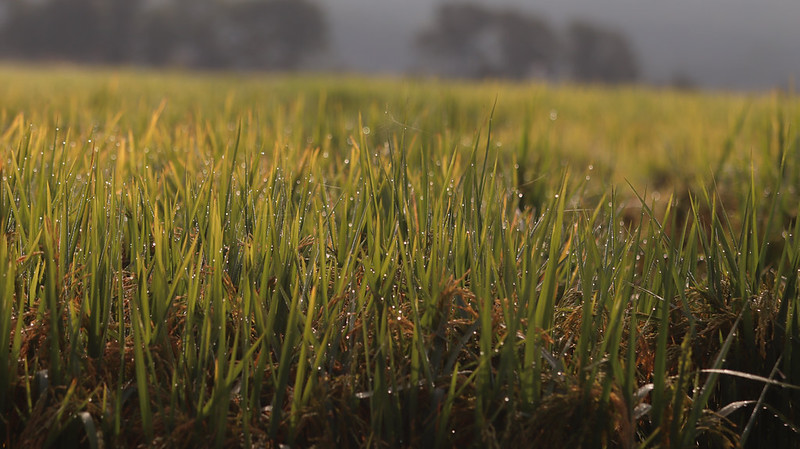
Jarrod Hardke, extension rice agronomist for the University of Arkansas Division of Agriculture, said most of March and April were abnormally dry and warm, with both daytime and nighttime low temperatures falling significantly with May’s arrival.
“That really put the crop into an interesting position, over seven to 10 cooler days and nights, with cloudy weather every day,” Hardke said. “It was very stressful for the crop. Add in unrelenting winds through the entire spring — the crop didn’t like that any more than the drought conditions.”
Hardke said that in addition to damaging emerged rice plants, wind can also impact rice seeds, which tend to be planted shallowly in soil.
“Given the high winds and how warm it was, that upper soil dried out very quickly after planting,” he said. “We struggled with getting enough moisture for rice seed to germinate and achieve a stand.”
Farmers have also been dealing with erratic stands, meaning that plants are not emerging along uniform timelines, complicating pesticide applications, fertilization and flooding.
“We have some rice plants coming up in a field, and three weeks later, additional plants emerging with a small rain or increased humidity,” Hardke said. “So we have three- and four-leaf rice plants next to one-leaf rice plants. Uniform plant stands and progress are much more viable.”
The current National Weather Service forecast indicates rain and thunderstorms are likely across the entire state throughout the Memorial Day weekend. Hardke said rain is welcome in the short term, but that farmers will also need dry windows soon for crop management.
“We need to have dry soil conditions at certain times, such as during nitrogen fertilization,” he said. “For some of those key management windows, we need things to cooperate a little bit in order to maximize our efficiency and yield potential.”
While Arkansas farmers plan to plant only about 1 million acres of rice this year, according to the U.S. Department of Agriculture’s Prospective Plantings report in March, the lowest acreage in recent memory may produce higher per-acre yields. Hardke said that in years where acreage falls, farmers tend to keep rice plantings on their fields best suited for the crop.
To learn about extension programs in Arkansas, contact your local Cooperative Extension Service agent or visit uaex.uada.edu. Follow us on Facebook and Instagram. To learn more about the Division of Agriculture, visit uada.edu. To learn more about ag and food research in Arkansas, visit the Arkansas Agricultural Experiment Station at aaes.uada.edu.
About the Division of Agriculture
The University of Arkansas Division of Agriculture’s mission is to strengthen agriculture, communities, and families by connecting trusted research to the adoption of best practices. Through the Agricultural Experiment Station and the Cooperative Extension Service, the Division of Agriculture conducts research and extension work within the nation’s historic land grant education system.
The Division of Agriculture is one of 22 entities within the University of Arkansas System. It has offices in all 75 counties in Arkansas and faculty on three campuses.
Pursuant to 7 CFR § 15.3, the University of Arkansas Division of Agriculture offers all its Extension and Research programs and services (including employment) without regard to race, color, sex, national origin, religion, age, disability, marital or veteran status, genetic information, sexual preference, pregnancy or any other legally protected status, and is an equal opportunity institution.
# # #
Media Contact:
Ryan McGeeney
rmcgeeney@uada.edu
501-671-2120