Rotational grazing a key practice to maintain forage in drought
Oct. 26, 2026
By Mary Hightower
University of Arkansas Division of Agriculture
Fast Facts
- 30 Arkansas Forage and Grassland Fall Conference to highlight drought strategies
- Simon: Still time to plant winter forages
(293 words)
(Newsrooms: Note time-sensitive item in 9th graf.)
With related stories:
- Arkansas may see drought relief over the winter
- Drought among factors jostling cattle markets
- Drought raises nitrate risks in forage, boosts costs for ranchers
SARDIS, Ark. — Best management practices are essential for being able to survive a
drought, said Kenny Simon, extension forages instructor for the University of Arkansas
Division of Agriculture.
“I’ve often said best management practices, or BMP’s, are more important when we have
limited forage supply than when it’s rainy and we have an abundance of grass,” he
said.
This year’s prolonged drought has put a strain on the plants that make up pastures and hay meadows across Arkansas.
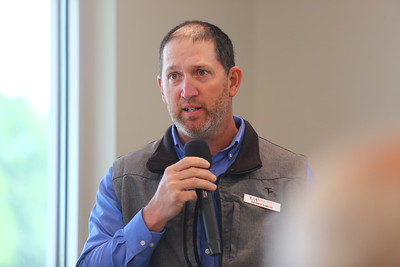
“Forages need time to rest and recover,” Simon said. “Consider confining the livestock to one field at a time and feeding hay.
Hay is not only a source of nutrients for the animals but it’s also a source of nutrients for the soil.
“Move the hay feeding spot each time you put out a new bale,” Simon said. “Then once you’ve fed hay across the field move to the next field. Start in the lower parts of your farm now while it’s dry then work you’ve way to higher ground.”
Simon said here’s still time to plant winter annuals such as ryegrass or small grains like wheat, cereal rye, oats, or triticale.
“For late winter and early spring grazing we need to plant by Oct. 31,” he said. “However, planting by mid-November can still provide some early grazing in spring. Planting ryegrass or oats around March 1 can provide for an early hay crop.”
Simon and other speakers will be discussing drought management and drought recovery strategies on Oct. 30 at the Arkansas Forage and Grassland Fall Conference at the Crossroads Cowboy Church in El Paso.
Registration will be available day of the event: $45 per person or $20 per student. Registration is payable by cash, card, or check. To register, contact Addie Stamps at addie.stamps@arfb.com or 501-607-8978.
RESOURCES
To learn about extension programs in Arkansas, contact your local Cooperative Extension Service agent or visit uaex.uada.edu. Follow us on Facebook and Instagram. To learn more about the Division of Agriculture, visit uada.edu. To learn more about ag and food research in Arkansas, visit the Arkansas Agricultural Experiment Station at aaes.uada.edu.
RELATED STORIES
- Arkansas may see drought relief over the winter
- Drought among factors jostling cattle markets
- Drought raises nitrate risks in forage, boosts costs for ranchers
About UADA
The University of Arkansas Division of Agriculture’s mission is to strengthen agriculture, communities, and families by connecting trusted research to the adoption of best practices. Through the Agricultural Experiment Station and the Cooperative Extension Service, UADA conducts research and extension work within the nation’s historic land grant education system.
UADA is one of 22 entities within the University of Arkansas System. It has offices in all 75 counties in Arkansas and faculty on three university campuses.
Pursuant to 7 CFR § 15.3, UADA offers all its Extension and Research programs and services (including employment) without regard to race, color, sex, national origin, religion, age, disability, marital or veteran status, genetic information, sexual preference, pregnancy or any other legally protected status, and is an equal opportunity institution.
# # #
Media Contact:
Nick Kordsmeier
nkordsme@uada.edu